
The General Consent Trap
Why It Won’t Save You From Ambient AI Lawsuits

I’ve been having lots of conversations around consent for ambient AI scribe services and what it should look like, especially in the ED. Some advocate for just another checkbox or line in the general consent to treatment, but that’s a legal trap. Let’s get into why. As always, if you have enjoyed reading the newsletter, subscribe (it’s free) and tell a friend.
Sam
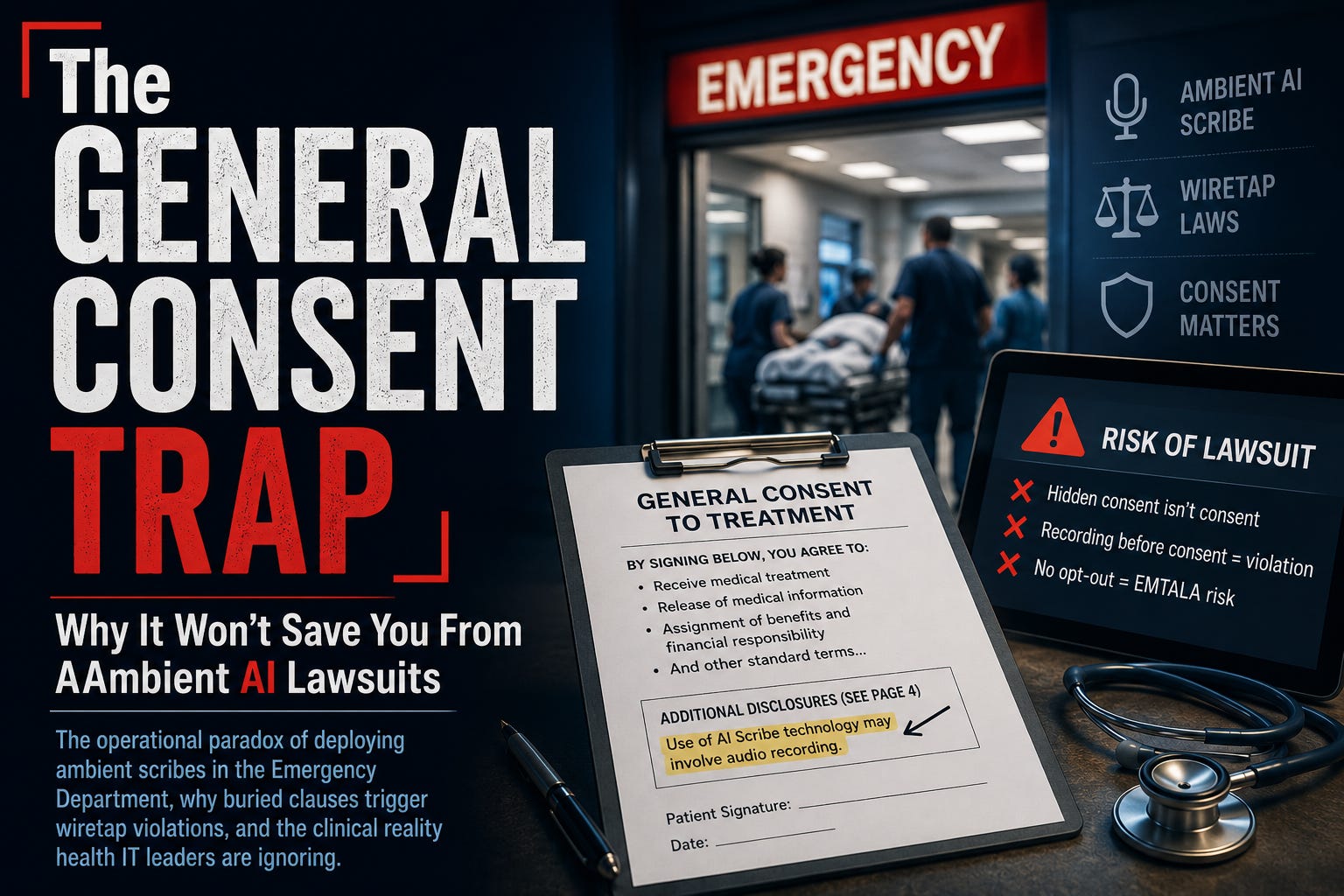
In my May 10th newsletter, I wrote that the first wave of major lawsuits involving ambient AI scribes is not about clinical errors or hallucinations, but about patient consent.
Specifically, the high-profile class-action litigation against hospital systems that use tools like Abridge centers on wiretapping statutes and how audio data is transmitted to third-party servers.
Since that piece went out, I’ve had several conversations with hospital executives and digital health leaders. The prevailing consensus among administrative teams seems to be: “We’ll just add a line explicitly disclosing the AI scribe inside our standard, general intake paperwork. Problem solved.” It’s an efficient, tidy administrative fix. It’s also a massive legal liability trap, especially if you practice in the Emergency Department.
When hospital systems sign enterprise agreements with ambient AI vendors, they are almost universally designing their compliance workflows around calm, predictable, elective outpatient clinics. They rarely consult the actual mechanics of state wiretap statutes or consider how those laws interact with a chaotic ED filled with incapacitated, uncooperative, or altered patients.
Let’s unpack three blind spots that are turning standard enterprise AI rollouts into ticking compliance bombs.
Blind Spot 1: The Fallacy of the “Hidden Line”
The administrative strategy to bury an AI disclosure on page 4 of a massive General Consent to Treatment or a Notice of Privacy Practices (NPP) assumes that ambient AI is just another standard electronic operation.
Under HIPAA, this makes perfect sense. Because major vendors sign strict, HIPAA-compliant Business Associate Agreements (BAAs) with health systems, the act of transcribing a medical note is legally treated as routine healthcare operations.
But here’s the glitch: State wiretap and eavesdropping laws operate completely independently of HIPAA.
In strict all-party consent states such as California, Florida, Illinois, and Pennsylvania, the law mandates that every participant in a confidential conversation must explicitly authorize its recording. Burying a generic clause in a mountain of digital check-in forms does not constitute the “meaningful, explicit consent” required to record a person’s voice.
The active lawsuits explicitly hinge on this exact point. Plaintiffs argue that while they may have signed general intake paperwork authorizing medical care and standard data handling, they lacked clear, conspicuous notice that their live conversations were being captured and fed into external AI infrastructure.
If your health system relies solely on hidden lines in a general consent packet to shield it from all-party wiretap claims, your shield is paper-thin.
Blind Spot 2: The “Prior Consent” Sequence Error
Even if you rely heavily on verbal bedside consent, the chronological order in which that consent is captured matters immensely.
Under wiretap statutes, authorization must be prior consent. The moment a mobile app or microphone activates and begins capturing, caching, or processing audio data from a confidential clinical interaction without the patient’s permission, a technical statutory violation has occurred.
Legally speaking, you cannot record a patient to obtain consent for that same recording. This exposes a massive flaw in the software workflow. Many ambient AI tools feature a “one-click” workflow integrated into mobile EHR apps. A slammed physician walks into an exam room, hits “Record” on their device, and then says to the patient, “Hey, I’m using an AI assistant to write my note today, is that cool?”
If the patient says yes, the doctor thinks they are safe. They aren’t. In an all-party consent state, that audio file now contains discoverable proof of a technical wiretap violation because the recording app was actively capturing audio data before permission was granted.
True safety mandates a strict clinical sequence: Talk → Consent → Click.
The consent itself should not be part of the audio recording. It is legally documented through entirely different mechanisms: a digital opt-in checkbox at check-in or a structured, timestamped attestation hard-coded into the EHR chart note.
Blind Spot 3: The Opt-Out Paradox, Billing, and EMTALA
For consent to be legally valid, it cannot be coerced. That means patients must have a clear, frictionless right to refuse the AI recording without it impacting their care.
To understand why this breaks down in the ED, we have to look at what a General Consent form actually does. Frontline clinicians often see it as a simple “permission to treat” form, but hospital executives and billing personnel see it as the facility's financial lifeline. It is where a patient signs an Assignment of Benefits, allowing the hospital to bill their insurance directly and legally accept Financial Responsibility.
In a standard outpatient clinic, if a patient refuses to sign the general intake packet, the workflow stops. They can’t be registered, they don’t get seen, and they leave.
But under the federal Emergency Medical Treatment and Labor Act (EMTALA), the ED operates under a completely different legal framework. If a patient presents to triage with an emergent condition and refuses to sign the intake forms, or intentionally strikes out the newly added “AI Recording Clause”, you cannot turn them away. The hospital is legally mandated to provide a Medical Screening Exam (MSE) and stabilizing treatment regardless of what paperwork is signed.
This creates an operational paradox for hospital design. By piggybacking the AI recording disclosure onto the General Consent form, hospitals are taking an administrative document meant to secure billing rights and turning it into a liability shield for a state criminal wiretap law. If a patient opts out of the AI recording, they are forced to reject the packet.
Because of EMTALA, you still have to treat them. Consequently, hospitals are inadvertently creating a class of patients who are fully treated in the ED, but who have never signed the financial agreements the billing department needs to collect revenue.
Consenting to an ambient AI scribe can never be a mandatory prerequisite for emergency medical care. Therefore, an unbundled opt-out option must exist, and EDs must support a completely parallel manual documentation track for patients who decline the technology.
The Ultimate Clinical Trap: The Incapacitated Patient
This brings us to the ultimate legal cliff edge for an emergency physician: the altered or incapacitated patient.
In emergency medicine, we rely heavily on the Emergency Doctrine (Implied Consent). If a patient presents with severe trauma, an acute myocardial infarction, or an altered state, consent for life-saving clinical treatment is legally implied because a reasonable person would want their life saved.
But as I noted earlier, state wiretap laws do not contain a “Medical Documentation Exception” for emergencies. Wiretap statutes were drafted to protect privacy against electronic interception. They do not view optimizing an EHR charting workflow or reducing a doctor’s administrative burnout as a life-saving function that overrides a citizen’s right to digital privacy.
Consider a typical Friday night in any metropolitan ED:
A severely intoxicated patient who is technically verbal but clinically lacks the capacity to enter an agreement.
An acutely psychotic or paranoid patient who is shouting or unable to comprehend a disclosure.
An obtunded or delirious elderly patient presenting without family.
If you ask an intoxicated patient if you can use an AI scribe and they mumble, “Yeah, whatever,” that consent is legally void. If you click record anyway, you have just captured highly sensitive, confidential medical information from a vulnerable, incapacitated individual without prior legal consent. In an all-party consent state, that is a technical felony violation of a wiretap statute.
Ironically, these high-acuity, altered, and behavioral health charts are the exact, high-liability cases where emergency physicians want the most precise, flawless documentation to protect themselves from malpractice. Yet, under the law, these are the exact circumstances where using an ambient AI scribe is strictly contraindicated unless a Legally Authorized Representative (LAR) or surrogate is at the bedside to provide prior consent.
The Bottom Line for Health Leaders
Hospital IT and compliance teams need to wake up to “Enterprise Implementation Blindness.” Forcing 100% ambient AI adoption through bundled, financial intake forms is a direct path to a wiretap, billing, or EMTALA violation.
If your health system is rolling out tools like Abridge, the compliance framework must match the clinical reality of the environment:
Unbundle the Forms: AI disclosure must be an isolated, independent selection or digital checkbox—never bundled into the core financial consent to treatment.
Hard-Code the EHR “Off-Switch”: If a patient opts out at triage, the recording button in the integrated EHR interface (like Epic Haiku) must be automatically greyed out or flagged with a prominent warning banner to prevent accidental illegal recordings.
Draft Strict ED Clinical Contraindications: Compliance teams must issue clear directives stating that ambient AI scribes are completely contraindicated for any patient who is incapacitated, severely altered, or lacking an appropriate surrogate to give valid, prior verbal consent.
When the patient is alone and altered, the mandate is clear: Turn the app off, and revert to a manual clinical workflow. Patient autonomy and wiretap laws trump administrative efficiency every single time.