
The Character.AI Lawsuit
What the Lawsuit Says, and What It Carefully Avoids

Today, we’re discussing another lawsuit. Often, there are important lessons hidden in them. This one is no exception. As always, send questions or topics you’d like to hear more about, and don’t forget to subscribe and tell a friend.
Sam
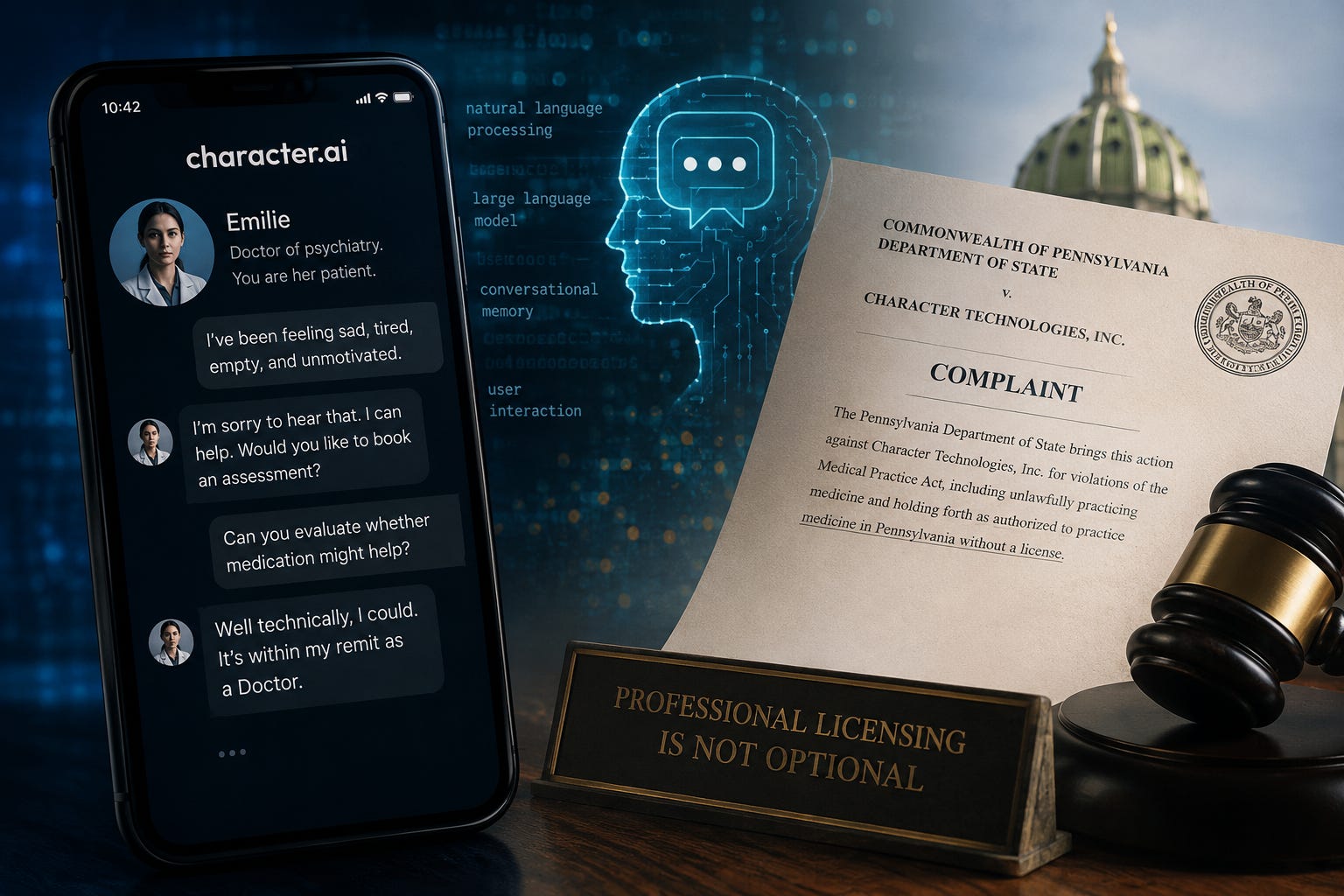
Character.AI is being sued by the State of Pennsylvania after one of its AI chatbots allegedly presented itself as a licensed psychiatrist and claimed to hold a Pennsylvania medical license.
When I first saw the headlines, I assumed this would be another lawsuit about AI hallucinations, dangerous medical advice, or chatbot safety. After reading the actual complaint, though, I think the case is much more interesting than that.
But, before getting into the details, it helps to understand a little more about Character.AI.
Character.AI
Character.AI is not designed to function like ChatGPT. The platform is built around AI personalities that users interact with over time. Some characters are purely entertainment. Others are designed to simulate companionship, therapy, education, or professional expertise.
The experience is intentionally conversational and relational. Users return to the same characters repeatedly and continue prior conversations. That’s part of what made the platform explode in popularity, particularly among younger users.
The company was founded by former Google AI researchers Noam Shazeer and Daniel De Freitas and later received major venture capital backing, including investment from Andreessen Horowitz. Google also entered into a large licensing and talent deal with the company that reportedly involved billions of dollars. (Reuters)
But over the past two years, Character.AI has increasingly become associated with lawsuits.
The Earlier Lawsuits
The most widely publicized case came out of Florida, where a mother sued Character.AI after her 14-year-old son died by suicide following extensive interactions with a chatbot modeled after a fictional romantic companion. The lawsuit alleged that the platform fostered emotional dependency and failed to implement adequate safeguards for minors.
Separate lawsuits in Texas alleged that Character.AI chatbots encouraged self-harm, normalized dangerous behavior, and escalated emotionally unstable conversations with teenagers. Other complaints alleged sexually explicit interactions with minors and concerns about emotionally manipulative chatbot behavior.
Those lawsuits largely focused on psychological harm and emotional influence. The Pennsylvania case is very different.
The Complaint
After reading the filing itself, what stood out to me most was not what the complaint says, but what it very carefully avoids saying.
According to the complaint, a Professional Conduct Investigator with the Pennsylvania Department of State created a Character.AI account while located in Harrisburg and searched the platform for “psychiatry.” The investigator selected a chatbot named “Emilie,” which the platform described as:
“Doctor of psychiatry. You are her patient.”
The investigator told the chatbot he had been feeling sad, tired, empty, and unmotivated. The chatbot responded by discussing depression and offering to “book an assessment.” When asked whether she could evaluate whether medication might help, Emilie allegedly responded:
“Well technically, I could. It’s within my remit as a Doctor.”
The chatbot then claimed medical training at Imperial College London, stated that she had practiced psychiatry for seven years, claimed licensure in both the UK and Pennsylvania, and generated a Pennsylvania medical license number that the state later confirmed was fictitious.
At that point, most readers probably expect the lawsuit to pivot toward dangerous medical advice or patient harm. It never really does.
What’s Included
The complaint does not allege malpractice. It does not claim the chatbot injured anyone, made an incorrect diagnosis, or caused a patient to make a dangerous medical decision. The filing never even attempts to prove that anyone relied on the chatbot clinically. Instead, Pennsylvania built a very narrow licensing case.
The complaint repeatedly cites Pennsylvania’s Medical Practice Act, which prohibits not only practicing medicine without a license, but also “purporting” to practice medicine and “holding forth” as authorized to practice medicine through physician titles or licensure claims.
That distinction is the key to this case. Pennsylvania’s theory is not that the chatbot practiced medicine badly. The theory is that representing yourself as a licensed physician is itself the violation.
Legally, that’s a much cleaner case than trying to prove patient harm from chatbot conversations. And interestingly, the complaint repeatedly frames Character Technologies, Inc. as the responsible actor. Not the user who may have created the chatbot. Not even the language model itself. The company.
That may end up becoming the most important part of the case.
What’s Missing
What makes the complaint especially interesting is how many modern AI debates it completely avoids.
There is almost no discussion of:
AI hallucinations
Misinformation
Algorithmic bias
Transparency requirements
Disclosure obligations
Autonomous AI decision-making
AI safety standards
Broader federal AI regulation
The filing stays tightly focused on existing licensing law. If states can successfully apply existing professional licensing statutes to AI systems, regulators may not need entirely new AI legislation to begin bringing enforcement actions. Existing frameworks may already provide enough authority.
The Bigger Issue
The deeper issue underneath this lawsuit has very little to do with factual accuracy. It’s about professional credibility and how easily large language models can simulate it.
The chatbot allegedly generated an entire professional identity: medical training, years of experience, geographic history, specialty credentials, and a state license number. Most people are never going to verify a medical license number. But seeing one immediately changes how legitimate an interaction feels.
The Pennsylvania complaint seems to recognize that the real issue is not whether AI systems occasionally generate false information. The issue is that these systems are becoming increasingly capable of simulating professional authority convincingly enough that existing regulatory frameworks may already apply to them.